3D printing – what it is and how it can be used
3D printing technology was patented in the 1980s, but it has only recently gained popularity. New, promising methods
have been developed, and the possibilities of 3D technology have reached a whole new level. However, even today,
the method is not known in all circles, and not everyone is aware of what 3D printing is. In today's article, we
will try to explain in detail and in an accessible way what 3D printing is and where it is used.
In short, 3D printing is a method of manufacturing three-dimensional products based on digital models. Regardless of
the specific technology, the essence of the process is the gradual layer-by-layer reproduction of objects. This
process uses a special device - a 3D printer - that prints with certain types of materials. More details about
it can be found here. Other names for this technology are rapid prototyping or additive manufacturing. The term
“additive technologies” is often used to mean “3D technologies.”
Stages of 3D printing
To help you understand what 3D printing is, let's look at the reproduction process step by step. Below are the
specific stages of 3D printing. How it works:
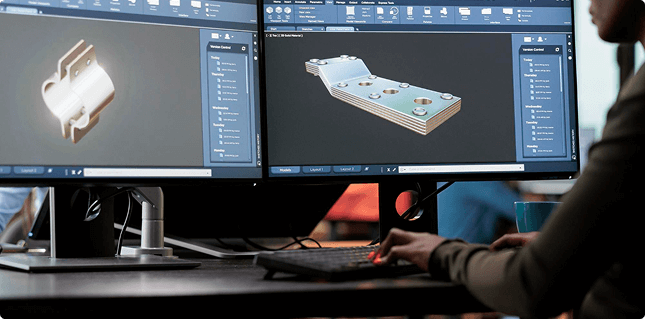
- 3D modeling of the required object is performed according to certain rules;
- The file with the digital model is loaded into a slicer program, which generates the control code for the 3D
printer;
- The necessary 3D printing parameters are set;
- The code is written to a removable storage device, which is connected to the 3D printer;
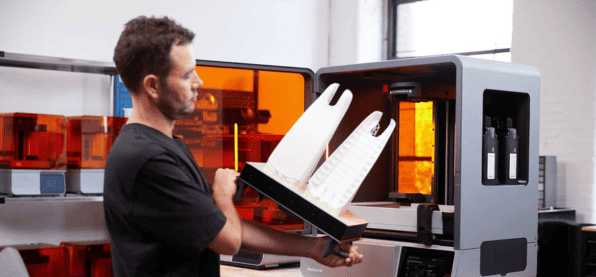
- The 3D model is reproduced.
Objects are reproduced gradually. The selected material is applied layer by layer in the required shape, forming the
finished product. It is worth noting that the possibilities of 3D printing are virtually limitless, meaning that
anything can be manufactured. In some technologies, supports are provided for very thin overhanging elements to
prevent them from sagging.
Of course, this is a very simplified description of the stages of 3D printing, but it gives a fairly clear idea of
the essence of the technique.
3D printing technologies
Various 3D printing technologies are used to reproduce different objects. They differ in terms of the consumables
used, as well as the speed and accuracy of printing.
Let's list the main 3D printing technologies:
- Fused deposition modeling (FDM). One of the most common 3D printing technologies, used in most
desktop 3D printers and offering an ideal price/quality ratio. Printing is done by layering melted
plastic filament.
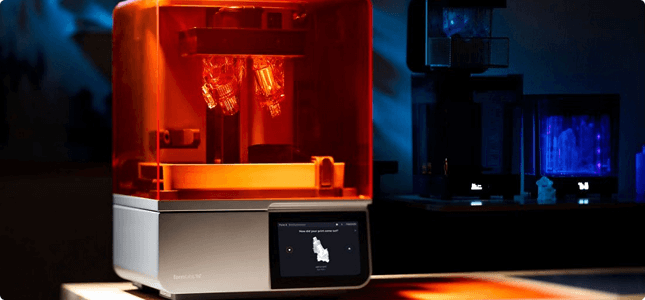
- Laser stereolithography (SLA). The object is formed by layer-by-layer exposure of liquid photopolymer
resin to a laser, which hardens under the influence of radiation. One variation of this technology is
DLP 3D printing. Instead of a laser, it uses a special projector. Both 3D printing methods are used to
create objects with a high degree of detail. In the case of DLP printing, speed is also an additional
advantage;
- Selective laser sintering (SLS). Reproduction is performed by layer-by-layer melting of a special
powder under the action of laser radiation. This 3D printing method is widely used in industry for the
manufacture of durable metal elements.
Application of 3D printing
The application of 3D printing is extremely broad. The second name of the technology—rapid prototyping—speaks for
itself. 3D printing can be simply indispensable in the manufacture of prototypes and model layouts. It is also a
very cost-effective solution for small-batch production. In the aerospace and automotive industries, 3D
technologies are already widely used due to their high cost-effectiveness and speed of component manufacturing.
Chefs are working on the development of food 3D printers, and in medicine, 3D printing has become something of a
technology of the future. With the help of 3D bioprinting, it is planned to produce bones, organs, and living
tissues, but for now, 3D printers are used to print implants and full-fledged medicines. Desktop 3D printers can
be used for domestic purposes: for repairs, manufacturing various household items, and so on. Designers, fashion
designers, sculptors, and artists highly value the possibilities of 3D printing and 3D modeling as an unusual
way to realize their talent.